
What is Growth Marketing & What’s Critical for Success in the Growth function?
What does a growth marketer do?
Given that the function of growth marketing is fairly new, the question of what the function is or why a company even needs one is quite common. When I first became a growth marketer, I didn’t even know what my role fully encompassed. I thought about it alot
I learned that growth marketers use data and marketing to create business growth through innovative and data-driven strategies across various digital channels, including paid search, social media, display advertising, and SEO, overseeing the whole user funnel from acquisition to retention.
A growth marketing manager also prioritises experimentation by testing different approaches to see what yields the best results, building a data-driven growth culture within the company. This culture is characterised by continuous testing, learning, and iterating, which leads to sustained business growth.
What I love about it though, is it’s a cross-functional role that transverses both product and data and marketing.
Who needs growth marketers anyway?
According to Stuart Brameld, Growth Method CEO & Growth Advisor:
“Every modern business should have a growth marketing manager because they can help the company drive customer acquisition, convert leads, and expand market reach through tested, data-driven strategies.”
This is great news for growth marketers: growth marketing roles are growing!
Growth and growth marketing related roles were consistently placed in the top 10 fastest-growing roles worldwide. According to LinkedIn’s study of jobs on the rise in 2023, growth-related roles were at the top.
An analysis by Lenny Rachitsky of Lenny’s Newsletter shows that growth roles have increased by over 117% in the US in the past 2 years. In the US, growth roles are one of the fastest-growing roles right now within the tech industry (data as of July 2024).
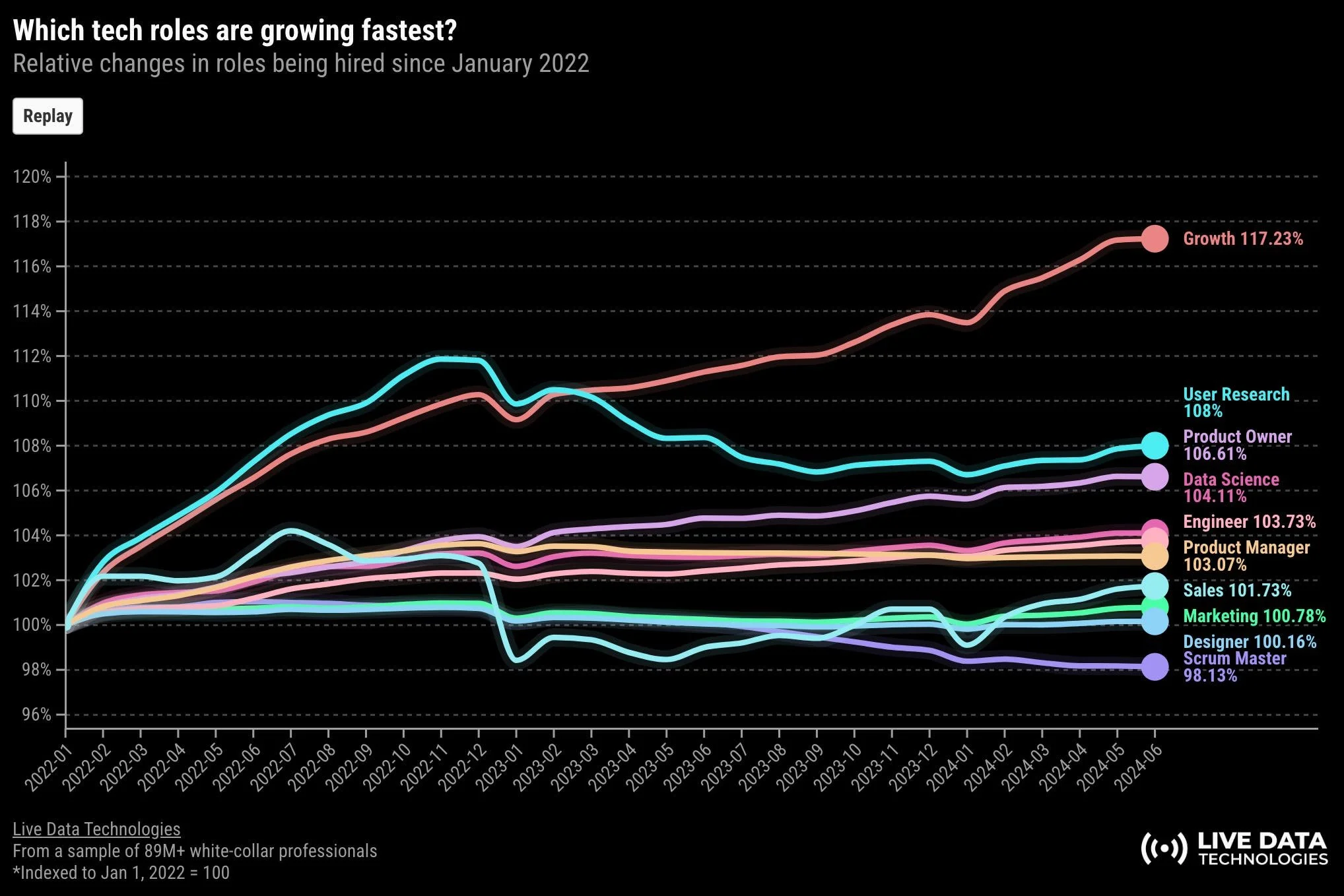
To give you a sense of scale, there are about 80,000 active “growth” roles in the U.S. right now and about 1,000 to 2,000 growth hires made per month.
This is because as many companies try to find profitability and revenues, the growth role becomes increasingly crucial to maintaining their edge over competitors. Think of this in terms of start ups, tech companies and just any company that wants to grow their business in a sustainable way through a concerted digital strategy.
It’s an exciting time to be in a “growth” role now, right?
But what a “growth” role is varies from company to company.
Having looked at various job descriptions for growth roles, I’ve seen growth roles also encompass what were typically business development or sales roles. It’s so widely applied that it has become hackneyed. Here is a sample description from a “growth director” role I found on LinkedIn:
As an Account Director, your role will focus on bringing in and growing new and existing client accounts, whilst working with members of the senior leadership team. What you'll be doing:
Leading new business pitches
Growing existing client accounts
Leading and delivering new business efforts such as RFIs, RFQs, and RFPs
Helping to convert warm leads into clients
This sounds more like sales and business development, which I suppose is expected as the company is an agency, and growth means finding new clients for them.
Here’s another for “Head of Growth”:
Join us as the mastermind behind our global user acquisition, engagement, and retention strategies. As the Head of User Growth, you'll lead a newly established team in performance marketing, gamification, CRM, operations, and content to drive sustainable growth for our mobile app on a global basis.
The job title is similar but the description is completely different. That’s because not all growth roles are created equal.
I believe that every growth role will be unique and that the level of the skill set required will vary across companies because companies of different sizes will have different needs. However, what’s critical for success within the role is fundamentally the same across all companies.
What’s critical for success in the ‘Growth’ role
In my opinion, there are five key criteria that are critical for success in any growth role.
1. Understanding the company’s key business growth drivers
This is probably critical to any business role, but it’s often harder to truly understand what makes a company tick when you’ve just joined. It’s hard to deliver value if you’re unsure about what drives growth. Growth drivers are different from channels. Increasing demand for your product is a growth driver, but what factors drive that demand?
At my current company, early-stage growth was driven simply by the number of banking partners we had. Without partners, users couldn’t onboard. Once partnerships expanded, users grew exponentially. Later, other factors became more important.
2. Understanding your target users or customers
This sounds obvious, but do you really know your customers? Can you put yourself in their shoes? Communication becomes difficult if you don’t understand them deeply.
For example, when we had to communicate a reduction in interest rates for a savings product, we anticipated backlash. Instead of mass emailing, we engaged VIP and influential users through community managers and in-person sessions with senior leaders. By explaining product improvements and value propositions, we managed sentiment through a softer, more thoughtful approach.
3. Knowing how to analyse and interpret data effectively
Data is the bedrock of growth. Understanding where data comes from, how it flows, and what’s available is crucial.
Without a solid grasp of data sources, insights are limited. While having analysts helps, the real advantage comes from growth marketers who can pull and analyse data themselves.
Data has saved me from making bad decisions many times. In one survey, we discovered referrals were a major acquisition channel and referred users were more loyal and higher value. This insight led us to pivot towards referrals, which drove a large portion of early growth.
4. Understanding growth channels and how to leverage them
There’s more to growth than channels such as SEO and paid ads. B2B and B2C both have wide channel options.
Understanding where your audience spends time and what content they engage with helps refine strategy. Each channel has its pros and cons, and knowing these nuances is critical.
Early on in the companies that I worked in, I started with organic content and email, then expanded into paid ads, SEO, affiliates, and referral strategies to drive more sustainable growth.
5. Strategic thinking, execution ability, and stakeholder management
Strategic thinking requires big-picture vision, while execution often means working closely with others. Think big, act low, meaning strategic big picture thinking and operating at a more operational level.
Managing multiple projects simultaneously is challenging. One example was my time as head of growth for a crypto exchange that collapsed. I worked with legal teams across Singapore, Thailand, and Indonesia, handled communications for over 200,000 affected users, and coordinated legally approved responses under intense pressure. It was stressful, but it taught me how to move fast, stay accurate, and execute under scrutiny.
What are your top factors critical for success?
Want to learn more about growth marketing and in-depth case studies? I hope to update this periodically as I reflect on the lessons and mistakes I’ve made over the past four years as a growth marketer.
